Nokalakevi's
locale The
site consists of a lower town and a citadel, set in a loop
of
the river Tekhuri where it emerges from a gorge in the mountains
onto the Colchian plain (to which Jason and the Argonauts are
said to have travelled). The lower town borders the river to
the
south and west and a steep slope to the north. Perched on the
crest of this ridge sits the citadel with fine views across
the
plain to the south and east. Walls connect the two parts of the
city. On the east side of the lower town, unprotected by nature,
successive rulers built three parallel defensive walls with
towers
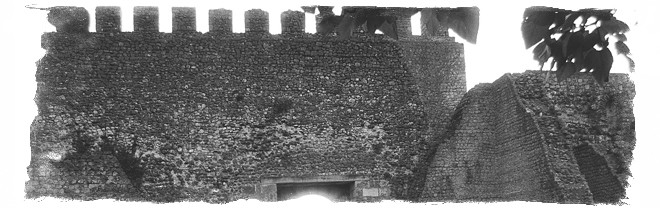
and a strongly fortified gate.
Overview
Begining
The Georgian Expedition
Civil War
The Anglo-Georgian Expedition
Site Chronology
Maps
The ruins at the village of Nokalakevi were recognised as historically
important as early as 1834 when the Swiss philologist Frederic
Dubois du Monpéreux identified them as the Colchian
Archaeopolis mentioned by the Late Roman historians Procopius
of Caesarea and Agathias of Myrina.
Archaeological
work was first undertaken in 1930 by the German archaeologist
A.M. Schneider who in excavating a tower and gateway,
discovered a hoard of Byzantine coins from the reign of
the Emperor
Maurice (584 -602). Excavations were not resumed until 1973 when the Janashia State Museum of History initiated
large-scale archaeological and conservation work at the
site and in the surrounding region up to 1991. After the collapse of the Soviet Union in 1991 and subsequent civil unrest in Georgia the expedition suffered severe damage to its infrastructure. In 2000 AGEN and the Georgian State Museum agreed to resume excavation, which continue until the present day.
Financed
by Not Gemeinschaf, Alphonse
Maria Schneider from Freiburg’s
University, went
to Georgia in December 1930 and sampled
the settlement by excavating 30 small trenches in different areas throughout the
site. Unfortunately, due to the political conflict between Russia and
Germany at the time, his work was stopped short after 2 months never to return.
In the intervening 42 years, the territory became densely wooded and the archaeopolis became occupied by 6 houses and a cemetery. A silk manufacture was also working there.
In 1973, the National
Museum formed the Nokalakevi expedition under the leadership of Parmen
Zakaraia. In the first 7 years, extensive work was undertaken to
prepare the Archaeopolis for excavation, clearing it of vegetation and occupation.
Between 1980 and 1990, the Georgian Expedition excavated 6 churches, (one from
4th century, 1 from the 5th Century and 4 from 6th century),
2 bath houses from the 4-6th century and 2 royal palaces from the 4-6th century
AD.
In addition, a well preserved tunnel,
a water
system, a number of watch
towers
and very strong fortification system, (which doesn't have any analogy
in the Caucasus) were also discovered.
With the latter structures being of the 4-6 centuries, a main research priority was to concentrate on
the architecture and archaeology of those
periods. With literature (Juansheri, Leonti Mroveli, Zime Vakhushti) also describing the area as a Hellenistic necropole during the 3rd to 2nd centuries
BC, excavations also took place to confirm these accounts.
Some of the most illuminating results of the excavations and research during this 10 year period shows a bead workshop, a small
metallurgy workshop and an area of likely ritual significance with the discovery of 100 pieces of ceramic zoomorphological
figurines. Some of the most important information to come out of this period of excavation is the stratigraphical matrix of the site, which is the only example from the area.
The idea of the present collaboration was first raised in private discussions
between Mr Colvin and Dr. Lomitashvili in 1999. In 2000 the British and Georgian
leaders of the expedition traveled to the site to explore possible research
agendas and work out details of strategy for archaeological excavation and
post-excavation work. It became clear at an early stage that there was still
a phenomenal amount
of information to be gleaned from the site and that in general it would be
beneficial to link up all existing records of survey and excavation results
with an ongoing
programme of archaeological works.
From 2001, excavation at Nokalakevi formally resumed under the The Anglo-Georgian Expedition and is growing from strength
to strength with committed research agendas.
Date
Period
Detail
Nokalakevi
pre-8th century BC
Late bronze/early iron age
'Qulha' mentioned in Urartian sources: including West Georgia & Tao-Klarjeti.
1st 'heroic' age ca. 12th c. BC: Jason & the Argonauts' mythical quest for the Golden Fleece in Colchis; Aeetes, his daughter Medea & his capital Aea, captured the imagination of later Greeks & Georgians.
8th-7th centuries BC
Pre-antique (end of early iron age)
Cimmerian and Scythian invasions of East & West Georgia destroy central authority.
Double-headed animal figurines; ritual hearths/squares; bead & metal workshops. First large scale ceramic finds—all produced locally.
6th-4th centuries BC
Early antique
Settlement of Ionian Greeks on East Black Sea coast. Kingdom of Colchis mentioned by Greek geographer pseudo-Scylax.
First imports of amphorae, black slip ceramics, jewellery and glass, from Attica, Ionia and Aegean. Local ceramics strongly represented in finds.
3rd-1st centuries BC
Hellenistic
Begins with Alexander the Great's semi-legendary contemporaries Parnavaz & Kuji last third of 4th century BC; ends with the Mithridatic wars, Pompey's invasion of the Caucasus 67/66 BC, and the subsequent Roman settlement of the East.
Continued imports & new styles of local production. Clay timber buildings; furnished pot burials, cremations & inhumations.
Kuji founds Tsikhegoji (Nokalakevi).
2nd Georgian 'heroic' age. 10th c AD Kartlian sources describe a legendary 'liberation' of Georgia from Alexander's Greeks & the unification of East & West Georgia under King Parnavaz & his deputy the West Georgian Eristavi (ruler) Kuji.
1st c. BC – 3rd c. AD
Roman
Pompey the Great's invasion through to Diocletian (284-305AD)/ Constantine (308-337) & the conversion of the Caucasus & Roman worlds to Christianity.
Largely absent from Nokalakevi; in West Georgia as a whole the vast majority of finds come from the coastal regions or the Kartli-Iberian borders. Literary sources (Arrian) describe four kingdoms in West Georgia: Lazika, Apsilia, Agasgia & Saniges.
4th-8th centuries AD
Byzantine
From Constantine the Great & Christianity to the first Arab invasions of West Georgia 735-7 AD (Murwan ibn Muhammad).
Majority of the visible standing architecture in upper & lower town is dated to 4th‑6th cc. AD. Byzantine literary sources describe Byzantine-Sasanian wars in unified Lazika-Egrisi, & in the South Caucasus in the 6th century. Armenian & Kartli-Iberian sources provide info on wider South Caucasian world. Later Georgian sources' interest in a 3rd 'heroic' age of 'unification' under Vakhtang Gorgasali.
8th-10th centuries AD
Abkhazian kingdom
From latter part of 8th century AD to Bagrat III's unification of Georgia in 978.
Very few finds in Nokalakevi from 6th century until 16th century.
10th-15th centuries AD
Bagratid period
From Bagrat III's unification of Georgia in 978 until the breakup of this first unified Georgian kingdom in second half of 15th century.
Possible 11th century additions to 40 Martyrs Church.
15th-19th centuries AD
Mingrelian principality
From the breakup of the first Georgian kingdom until Russia's protectorate of the Georgian principalities at the early 19th century.
A branch of the princely Dadiani family lived at Nokalakevi, constructed folly & church bell tower; repaired 'palace' and some earlier walls and towers. Work typified by mixed use of robbed stone from earlier walls and river cobbles.
19th century to 1973
Modern
From Russian annexation to the beginning of modern large-scale archaeological work.
Dubois du Montpéreux suggests (1833/9) that Nokalakevi may be Aeetes' 12th c. BC Aea and the Archaeopolis of the 6th c. AD Byzantine sources. Growing interest leads to 1930-1 expedition under Schneider & eventually to modern excavations, 1973-today.





 Copyright information: