Anglo-Georgian Expedition to Nokalakevi: Staff
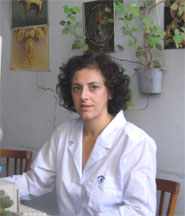
Professor Dr David Lomitashvili
Deputy Director of the National Agency for Cultural Heritage Preservation of Georgia
Master’s
Degree (Major): History
Tbilisi State University. 1980
Doctoral Candidate
of Science in History;
Archaeological material of IV and VI AD of Nokalakevi.
Issued by Board of Academic Experts of Georgia,
Nov 1990
Certificate
of training in Archaeological Studies, Museology, Conservation and
Excavation
Cairo University, Feb 2001
Doctor of science (Professor) in History. issued by Board of Academic Experts
of Georgia
Jan 2004
Certificate in 'Stratigic Planning workshop on the Future
of the Confederation and Arts Management
Professional
Development Programme
Issued by the Confederation - Art and Culture
May 2004
WORK EXPERIENCE
Currently, David's main interest is the 1st Millenium BC in Nokalakevi.
In 2005, David secured funds from the Ministry of Culture and
Sports for the renovation of the Nokalakevi Museum.
In 2000-2001, by the order of world Bank, David oversaw the conservation and restoration work carried out on the Egrisi Kings’ Palace
(VI c) in Nokalakevi.
In 1995, David oversaw the conservation of a
water basin (IV-V cc) unique in all the Caucasus and a fortification tower
in Nokalakevi (the capital of Egrisi Kingdom). The work was carried out by order of the “The Open Society of Georgia” foundation (the
Sorosi’s foundation).
1994 till today Deputy director of S.Janashia’s Museum
of Georgia
1991-1998 Lecturer at Tbilisi State University in History of
Georgia and Archaeology (affiliated with Akhaltsikhe)
1991-1994 Senior scientific researcher in the S.Janashia’s Museum of
Georgia.
1981-1990 Scientific researcher in the S.Janashia’s Museum of Georgia.
FIELD WORK
2003 till today The head of Nokalakevi’s archaeological
expedition
1981-2002 Deputy head of Nokalakevi’s archaeological
expedition
1977-1980 Deputy head of Pitsunda’s archaeological
expedition
PUBLICATIONS (last 10 of 42)
LOMITASHVILI David, 1999, On the study of one group of ceramics
from VI-Vcc B.C. of “Dzeglis megobari”, #1(104),
Tbilisi;
LOMITASHVILI David, 1999, “Materials for the history
of manufacturing in old Kolkida”, “Moambe” of
the Museum, #43-B, Tbilisi;
LOMITASHVILI David, LORTKIPANIDZE Beso, 2000, “On the
problem of intern development of west-Georgian town /by results
of archaeological researches on Nokalakevi settlement/ – International
scientific conference “The Archaeology and Ethnography
of Caucasus”, Baku;
LOMITASHVILI David, 1999-2001, “The ceramics of VIII-Vcc
B.C. from Nokalakevi” Annual of scientific works, #IV-V,
Tbilisi;. LOMITASHVILI David, LORTKIPANIDZE Beso, 2001, “The Murvan-deaf’s
invasion in Tsikhegoji by written sources”, The scientific
works of the professors and students, #-III, TSU, Tbilisi;
LOMITASHVILI David, 2002, “Nokalakevi I the culture
of workshop-settlements’ /the workshop for producing beads,
the Kolkhish-Egyptian analogs/ – The questions of the history
and theory of culture, #-XIII,
LOMITASHVILI David, COLVIN Ian, ARMOUR Nick, 2002, “The
early Christianity monument in Nokalakevi-Archaeopolosi”,
the VI-th Conference of Christian archaeology in the Center of
Archaeology, Tbilisi;
LOMITASHVILI David, KEBULADZE Nino, 1999, “The whetstones
or the touchstones”, “Dzeglis Megobari”, #4(107),
Tbilisi;
LOMITASHVILI David, KEBULADZE Nino, 1999, “Goldsmith
in VIII-VIIcc B.C. from Kolkhida (by materials of Nokalakevi)”, “Meskheti”,
TSU, v.III, Tbilisi;
LOMITASHVILI David, KEBULADZE Nino, 2000, “The goldsmith
in Kolkhida in VIII-VIIcc B.C./over the materials from the settlement
of Nokalakevi”, The actual problems of study of humanities,
Slovenian University, issue III, Baku
Dr Niko Murghulia
Head of Expedition
Member of the Archaeologcal council of the National Agency for Cultural Heritage Preservation of Georgia
Doctor of Archaeology
St. Andrew the First-Called Georgian University of the Patriarchate of Georgia
2013
Master of Humanities
Iv. Javakhishvili Tbilisi State University
2006
Bachelor of History sciences
Iv. Javakhishvili Tbilisi State University
2004
Niko's main inerest is in the Archaeology of West Georgia (Colchis and Egrisi). In 2007, he held the position of Archaeolgical scientist at the Georgian National Museum and later in 2011 became an assistant curator. He has been involved with the Anglo-Georgian Expedition since 2003, becoming a site supervisor in 2006, deputy head in 2011 and head of the expedition in 2014. Outside the expedition, Niko has been active in a number of projects aimed at the protection and restoration of historical and archaeological monuments in West Geoaria.
PUBLICATIONS:
2014 - I. Colvin, B. Lortkifanidze, N. Murgulia - Historical overview of Colchis-Egrisi-Lazika. Nokalakevi • Tsikhegoji • Archaeopolis. Archaeological excavations 2001–2010. Anglo-Georgian Expedition to Nokalakevi. BAR International series 2612, Archaeopress, Oxford, England. p. 1-11;
2014 - Coauthor - AGEN Trench A Results: 2001-2010. Coauthor. Nokalakevi • Tsikhegoji • Archaeopolis. Archaeological excavations 2001–2010. Anglo-Georgian Expedition to Nokalakevi. BAR International series 2612, Archaeopress, Oxford, England. p. 25-42.
2013 - D. Lomitashvili, N. Murgulia. Osindale Castle Complex. Bulletin of the Georgian National Museum, Vol. IV (49-B), p. 145-158
2013 - N. Murgulia. The Classification of the Egrisi Kingdom Fortifications. Bulletin of the Georgian National Museum, Vol. IV (49-B), p. 159-169
2013 - Coauthor - Report on excavation in 2010 by Anglo-Georgian expedition at Nokalakevi. DZIEBANI - Journal of the Georgian Archaeology, # 21, p. 44-63
2013 - N. Murgulia. The Subsystems of the fortification system of Egrisi Kingdom. Journal - "Iberia-Colchis", #9, pages 52-67, http://dspace.nplg.gov.ge/bitstream/1234/31101/1/Iberia_Kolxeti_2013_N9.pdf
2012 - N. Murgulia. The fortification System of the central part of the Egrisi Kingdom. Bulletin of the Georgian National Museum, Vol. III (48-B), p. 82-100.
2012 - G. Abdaladze, B. Kupatadze, N. Akhmeteli, N. Murgulia. History 11 (from ancient time to 18th c.). The schoolbook for 11th class pupils, approved by ministry of Education and science of Georgia. Diogene Publishers
2012 - G. Abdaladze, B. Kupatadze, N. Akhmeteli, N. Murgulia - History 12. 19th-20th cc. The schoolbook for 12th class pupils, approved by Ministry of education and science of Georgia; Diogene Publishers
2011 - P. Everill, P. Marter, D. Lomitashvili, N. Murgulia - Mapping Archaeopolis. Survey of multi-period site of Nokalakevi. Bulletin of the Georgian National Museum, vol. II (47-B), p. 102-115
Dr
Besik Lortkipanidze
History
Tbilisi State University.
1981
Candidate of Science (Doctoral) in History.
Issued Georgian
academy of science.
1991
Georgian history of the 4th-8th century AD
Certificate of
training in Archaeological
Studies, Museology, Conservation and
Excavation.
Cairo University.
Feb 2001.
In 1981, Beso started work in the Medieval archaeological department in the Georgia
State Museum and now holds the position of senior scientific worker. At the
same time he started working with the Georgian Expedition to Nokalakevi and
continues to this day as its deputy director.
In 1991, he submitted his thesis in history, themed on the cities in West Georgia
of the 4th – 8th centuries and specifically Archaeololis, Nokalakevi.
From 2000 Beso took the position as history teacher at 2 schools in Tbilisi
He is holding the position of 'expert' untill 2006 at the Ministry of Education, Georgia
He has published 20 academic articles in History and Archaeology in Tbilisi and
Baku and also 4 children’s books in the history of Georgia. In 2001 one of his children’s
books, entitled “the world of Georgian Mythology” was nominated for
the Georgian State Premium book prize.
He is the author of the new education standards (curriculum) in History and will
train teachers in this new standard from 2006.
Dr Nino Kebuladze
Master’s
Degree ( Major) Chemistry
Tbilisi
State University. 1985
Workshop certificate
in conservation
Shloss-Gottorf Museum (Germany).
2001
In 2004, she was
awarded her doctoral degree, which was entitled: “The scientific
bases of the restoration-conservation of archaeological metal”.
In 1986, Nino started work at the Chemical-Restoration
laboratory of the S.Janashia’s State Museum, Georgia
and in 2003 became head of the department.
Nino currently works on restoring and researching archaeological
metal,
glass
and
ceramics from all institutions in Georgia, these include the
Centre of Archaeological Research, Nokalakevi Museum, Batumi
Museum and Vani Museum.
In 2002 Nino became the Anglo-Georian
Expedition's chemical restorer.
Publications:
1. KEBULADZE Nino, LOMITASHVILI David, 1999, “The whetstones
or the touchstones”, (by materials of Nokalakevi)”, “Dzeglis
Megobari”, #4(107), Tbilisi;
2. KEBULADZE Nino, LOMITASHVILI David, 1999, “Goldsmith
in VIII-VIIcc B.C. from Kolkhida (by materials of Nokalakevi)”, “Meskheti”,
TSU, v.III, Tbilisi;
3. KEBULADZE Nino, LOMITASHVILI David, 2000, “The goldsmith
in Kolkhida in VIII-VIIcc B.C./over the materials from the settlement
of Nokalakevi”, The actual problems of study of humanities,
Slovenian University, issue III, Baku;
4. KEBULADZE Nino, TVALCHRELIDZE Zurab, GOTSIRIDZE Tina, 2000, “Note
on the study so-called “black Mass” was found in
the lamps of IX-Xcc”, “Archaeology and Ethnography
of Caucasus”, Baku;
5. KEBULADZE Nino, 2001, “The conservation of the archaeological
wet wood from the Choloqi side settlement” (West Georgia), “Dzeglis
Megobari”, #2; Tbilisi;
6. KEBULADZE Nino, 2002, “Corrosion of Iron and Restoration-Conservation
of Archaeological Artefacts”, “Dziebani” The
journal of the Centre for Archaeological Studies Georgian Academy
of Sciences, #10, ISSN 1512-0597, Tbilisi;
7. KEBULADZE Nino, ABESADZE Tsisana, 2002, “The history
of the chemical-restoration laboratory of the Georgian State
Museum”, “Moambe” of the Museum, #44, Tbilisi;
8. KEBULADZE Nino, 2003, “Note on the identification and
reason for a repeated corrosion product from Georgian State Museum
copper alloy artifacts”, Surface cleaning material and
methods-International conference, Restauratorentag des VDR, abstracts
of the lectures, No3, Bonn;
9. KEBULADZE Nino, MESKHIDZE Eka, 2004, “On the restoration
and conservation of the double zoomorphic figurines from the
city of Tsikhegoji-Archaeopolis” (West Georgia), Ukrainian
ceramological journal, #2-3, ISSN 1810-4843, Opishne.
10. KEBULADZE Nino, TVALCHRELIDZE Zurab, 2003-2004, “Note
on the study of the material was found in the lamps from Ivrispiri’s
Qvabebi”, “Moambe” of the Museum, #45, ISSN1512-1895,
Tbilisi.
Ian Colvin
Director AGEN
Researcher, University of Cambridge
2001-present Director Anglo-Georgian Archaeological Expedition to Nokalakevi
2005-present Researcher, CambridgeSCP, University of Cambridge
1999-2001 Junior Dean, Worcester College, Oxford
2000 International Summer School in Georgian Studies, Tbilisi State University
1996-2001 Master of Studies & DPhil Byzantine History, Senior Scholar, Worcester College, Oxford
My main research interests are the South Caucasus in Late Antiquity and the Late Roman classicising historians.
I began work on the South Caucasus over 20 years ago with an undergraduate thesis that later developed into a doctoral dissertation. I studied modern and classical Georgian as part of my doctoral studies at Oxford and I've been a regular visitor to Georgia and the Caucasus since 1998. I have a working knowledge of Georgian and wide experience of the country and the wider Transcaucasus. As Director of the archaeological expedition to Nokalakevi since 2001 I've had the privilege of introducing some 200 archaeological volunteers to Georgia, its history, archaeology and culture. I also lead specialist Historical and Archaeological tours for leading UK companies, Martin Randall, Andante Tours and Steppes Travel. I've worked at both Oxford and Cambridge, including supervising undergraduates for the Near East in the Age of Justinian and Muhammad option.
Selected Publications
Colvin, Ian, 'Comparing Procopius and Malalas', in Procopius of Caesarea: Literary and Historical Interpretations (Abingdon ; New York, NY, 2017), 201–14
Colvin, Ian, Besik Lortkipanidze, and Nikoloz Murghulia, ‘Historical Overview of Colchis-Egrisi-Lazika’, in Nokalakevi Tsikhegoji Archaeopolis: Archaeological excavations 2001-2010, BAR International Series, 2612 (Oxford: Archaeopress, 2014), pp. 1–11
Colvin, Ian, ‘Reporting Battles and Understanding Campaigns in Procopius and Agathias: Classicising Historians’ Use of Archived Documents as Sources’, in War and Warfare in Late Antiquity, Late Antique Archaeology, 8, 2 vols. (Leiden ; Boston: Brill, 2013), ii, 571–98
Colvin, Ian, ‘Nokalakevi: Excavations in the Land of the Golden Fleece’, Past Horizons, 2008, 26–31
Colvin, Ian, ‘The Early Christian Monument in Nokalakevi-Archaeopolis’, The 6th Conference on Christian Archaeology in the Centre of Archaeology, 2002, 13–16
Dr Paul Everill
Senior Lecturer in Applied Archaeological Techniques
MCIfA (Member of the Chartered Institute for Archaeologists)
Fellow of the Higher Education Academy (FHEA)
Fellow of the Society of Antiquaries of London (FSA)
Member of the British Institute at Ankara
PhD
University of Southampton, 2006
M.A.
University of Southampton, 1999
B.A. (Hons)
S.D.U.C., Lampeter, Wales 1994
I have been involved in archaeology, in some capacity or another,
since the age of 16 when I was a trainee on an excavation at Wroxeter
Roman city. Over the last 25 years I have seen field archaeology
through the eyes of a young amateur, an undergraduate student,
a postgraduate student and a full-time professional. As the Site
Director of the Anglo-Georgian Expedition I believe my priority
is to ensure that we have a well organised, professionally excavated
site, but I also hope that the volunteers we train each year experience
the same wonder, joy and passion for archaeology that I have experienced
over the years.
I have had the privilege to work on many stunning sites during
my career. These include Roman buildings excavated whilst I was
with the Museum of London Archaeology Service and described by
the "Evening Standard" as "London's Pompeii";
huge Iron Age farmsteads in the Cambridgeshire Fens; and impressive
Neolithic Cursus monuments in Dumfriesshire. However, I believe
that the site of Nokalakevi must rate as a world class archaeological
wonder, albeit little known at the moment, and represents an unmissable
experience for anyone with an interest in archaeology - regardless
of what stage of their career they may have reached.
Personally I remain excited by the opportunity to be involved
with this project and this site and, by expecting the highest
of standards from our volunteers, excited to think that the Anglo-Georgian
Expedition is adding its name to the prestigious history of Nokalakevi/
Archaeopolis
Benjamin Neil
Osteoarchaeologist, Cambridge Archaeological Unit
MPhil-PhD part-time research (2007-2012)
Cave bone taphonomy in the Yorkshire Dales
MSc
Forensic Archaeology
Bournemouth University
November 2000.
BA
Hons Archaeology and Anthropology
University of Wales, Lampeter
July 1998.
Areas of interest are osteoarchaeology, taphonomy, site formation processes and associated recording methodologies.
Geographic areas of interest are the Black Sea Littoral, specifically that of Helenistic Colchis and the Medieval and Meroitic periods
of Sudan.
As the osteologist for the Anglo-Georgian Expedition, I train
students in the excavation, recording and lifting of skeletons
and their associated contexts; further, they are guided on the
best practice for cleaning the skeletal material and its immediate
conservation. click here for a flash presentation the of Area B skeletal inhumations excavated in 2002
I am a member of the British Association for Bological Anthropology (BABAO), The Paleopathology Association (PPA), the
British Institute at Ankara (BIAA), and the Sudan Archaeological
Research Society (SARS).
Nicholas Armour
BA ancient History and Archaeology
Birmingham University
1993
Nick started his career as a field archaeologist in 1989 and continues to this day. He has excavated sites from the Neolithic through Roman to the late industrial period all over Britain.
Now settled in Cambridge, Nick specialises in the conservation of historic monuments.
In 2000, Ian Colvin asked Nick to carry out a feasibility study with Professor Lomitashvili of the possibility of a collaborative excavation of the Archaepolis in Nokalakevi. It was decided that a small scale excavation to further explore the stratigraphy and phasing of the site around the lower town fortifications was an important first step to further build on understanding the complexities of its occupation.
 Copyright information: Copyright information:
Anglo-Georgian
Expedition to Nokalakevi Copyright © 2001-2015 Armour-Colvin-Everill-Neil.
All rights reserved. Website design and construction
by Benjamin
Neil.
|